Monday, August 27, 2012

Why I Struggle over Blog Writing

It finally dawned on me why I have trouble writing some of my blogs: I can't decide whether I want to write  an op-ed or a scholarly article.

On the two following items I started out simply to state that Paul Ryan is Joseph Townsend in modern garb. Then the professor in me awakened, and I tried to show some awareness of the serious literature with all its scholarly apparatus.

When I had a real life working for (receiving?) an income, I was both a teacher and a preacher, but now when I'm writing blogs, I can't make up my mind which to be. 

Sometimes I end up being a messy mixture of both.

Paul Ryan and Joseph Townsend: Moral Theory of Poverty Alive and Well

Joseph Townsend in his Dissertation on the Poor Laws (1786) said, "Hunger will tame the fiercest animals, it will teach decency and civility, obedience and subjection, to the most perverse. . .  .  In general it is only hunger which can spur and goad the poor to labor."
http://socserv2.socsci.mcmaster.ca/econ/ugcm/3ll3/townsend/poorlaw.html  

Sadly, we have not come as far as one would wish from that dastardly sentiment. George Gilder in our generation asserted that the poor need the spur of poverty in order to succeed. His 1981 bestseller Wealth and Poverty was popular in the Reagan administration


Republicans, including some of my relatives and friends, are not far from Townsend and Gilder. The idea is that the poor are poor or have no work  because they are shiftless, lazy, good for nothing idlers unwilling to put in a hard day's work for whatever someone is willing to pay them.


Conservatives tend to think that the unemployment problem would go away if people were only sufficiently eager to work,  make good personal choices, would work at available wages, and go where the jobs are. Their mega-solution tends to be "Personal responsibility."  http://www.washingtonpost.com/opinions/the-myth-of-the-disappearing-middle-class/2012/03/29/gIQAsXlsjS_story.html

Besides, that's the way the market works; not much the government can do.
http://www.washingtonpost.com/opinions/robert-samuelson-saving-the-middle-class/2012/08/26/0f5be24a-ef9a-11e1-adc6-87dfa8eff430_story.html?hpid=z3

 Karl Polanyi quotes Ludwig von Mises as saying if workers "did not act as trade unionists, but reduced their demands and changed their locations and occupations according to the requirements of the labor market, they could eventually find work." Polanyi's response is apt: "It is not for the commodity to decide where it should be offered for sale, to what purpose it should be used, at what price it should be allowed to change hands, and in what manner it should be consumed or destroyed." Karl Polanyi, The Great Tranformation,  176.

Witness the latest "abomination of desolation" -- the offering of Paul Ryan as a candidate for vice-president.  He is at heart a Townsend wolf redvivus though in more politically expedient sheep's garb.  He breathes the air exhaled  by von Mises,  Friedrich Hayek The Road to Serfdom, and  (gasp!) Ayn Rand, Atlas Shrugged.  See Paul Krugman, http://www.nytimes.com/2012/08/24/opinion/krugman-galt-gold-and-god.html?_r=1&hp 

Alas, the moral theory of poverty is alive and well. We can only hope that it does not come to reside in the White House.

Why the Poor are Poor: Muticaualist Theory Needed

The Role of General Theory

Economic conditions and cultural patterns* tend to have persisting effects on individuals.  Change may be produced by a transformation of values that  have economic effects. This I take to be the import of Max Weber's The Protestant Ethic and the Spirit of Capitalism. 1904-5. Changes in material and technological conditions--the production and distribution of  goods and services --have political, social, and cultural consequences. This I take to be the import  of  the work of  Karl Marx, Friedrich Engels, and their followers. This ancient debate takes new forms but continues old themes on the causes and cures of poverty.

*For immediate working purposes, let culture mean what humans add to nature, including language, meanings, values, norms, and symbols.

Contemporary theorists bring into play both the values and behavior of the poor and the structural economic forces that shape their lives. The debatable questions have to do with the priority, sequence, and causal relations between them. The players have changed since I investigated the discussion in my The Passion for Equality, 1987, but I am not aware that the terms of the argument are substantially different. The nature, extent, and causes of the "underclass" have received a lot of attention since then.

A good summary of recent  research theory can be found in the Godkin Lecture at Harvard by William Julius Wilson,"The American Underclass: Inner-City Ghettos and the Norms of Citizenship" http://americanradioworks.publicradio.org/features/blackspeech/wjwilson.html 

More recent research is cited by Thomas Edsall in
http://campaignstops.blogs.nytimes.com/2012/09/16/is-poverty-a-kind-of-robbery/?hp

I have been impressed with Wilson's work:
The Declining Significance of Race: Blacks and Changing American Institutions (1978). 
The Truly Disadvantaged: The Inner City, the Underclass, and Public Policy (1987), 
More Than Just Race: Being Black and Poor in the Inner City (2009),

He has argued that  class is more useful than race in explaining black urban poverty today. He does not deny the destructive behavioral patterns in the ghetto but believes that the primary source lies in the underlying economic structures (loss of good-paying industrial jobs in black neighborhoods, e. g.) that resulted in a high rates of unemployment among black men, which makes them undesirable mates for black women. Today we would need to add the facts about the   incarceration of young black males related to our misguided, abhorrent drug policies that magnify the problem. This compounded with the lack of political commitment by either party to sufficiently robust structural changes that would benefit the poor and middles classes across racial lines makes for a discouraging situation with no end in sight.

It is difficult to know much to stress economic and structural factors as determinants of cultural practices and values.  In my opinion, it works both ways in a complex dynamic of interactive influences mutually reinforcing, limiting, or taking precedence over each other in ways that no single theory is likely to get just right. I hold all theories tentatively, skeptical of all claims that "at last we've got it." It is not easy to get  the full reality of things in a general theory, no matter how sophisticated and nuanced it is.

Urban poverty, specifically that of the black ghetto in the old industrial cities gets the most attention, but I have always been equally interested in rural poverty, among both blacks and whites, especially in the South, including Appalachia.

Liberals generally favor basic structural economic factors and social causes. Conservatives tend to

(1) have an excessive individualism that minimizes the general  socio-economic  conditions--lack of opportunity, and high rates of unemployment, etc.--where the poor reside. They ignore the destructive effects of familial, social, and cultural conditions on children growing up that work against the development of  the personal responsibility that is  their overarching moral principle or

(2) fall into  a defeatist, despairing cultural theory. This approach stresses how behavior, attitudes, and values trap the poor into  economic failure over generations.  They follow this theme regardless of and independently of how appalling structural economic factors may be productive of the cultural framework thus generated. (See the lecture by William Julius Wilson previously mentioned for an excellent summary of the trajectory of the "culture of poverty" thesis.)


In short, they may ignore the social conditions that work against the development of individual responsibility, or they may proffer a "culture of poverty" thesis that makes the situation so hopeless that no government action will be effective enough to matter much. A variant is Lawrence Mead who thinks that the poor  value work but are defeated and discouraged by their situation. He argues that personal responsibility should be enforced by requiring recipients to work in order to receive benefits  ("the new paternalism"). See The New Politics of Poverty: The Nonworking Poor in America (1993). His work is behind the reform of welfare in the Clinton administration.

Conservatives and liberals, like Heinz products, come in 57 varieties. Many of all persuasions ignore the role of luck or the absence thereof in individual success or failure.

The Importance of Individual Stories
Stories are concrete and may  capture more of the full reality than abstract theories, although stories can leave out much as well, i. e., not tell the whole story. Here are a few samples:

From  Joseph Loconte:
http://www.huffingtonpost.com/joseph-loconte-phd/a-poverty-of-imagination_b_1833780.html
Consider a homeless man named Walter. . . .  who had just received a supply of new needles, courtesy of the taxpayers of New York.

Walter admitted to me that he wasn't using the needles himself; he was selling them on the street for bags of heroin. (Lots of other addicts at needle-exchange programs do the same.) I asked him if he could picture his life without drugs. Could he imagine himself clean, employed, married, maybe a homeowner? I'll never forget his answer: "I'm way past that," he said. "The best thing I do is getting high ... Just put me on an island and don't mess with me."

From William Julius Wilson:
Godkin Lecture, loc. cit.
Curtis .. . . has been working for several years as a dishwasher for different employers. He now cooks, mops, and washes dishes for $4.85 an hour. He has held this job since February of 1985 without taking a single day of vacation. His supervisor has made it crystal clear to him that he is expendable and that if he takes too much, that is, any vacation, they will not keep him. On the day of the interview, he had had a molar pulled and was in great pain, partly due to the fact that not having any money and having already borrowed cash to pay for the extraction, he could not buy the prescribed pain-killers. Yet he was extremely reluctant to call his boss and ask for an evening off. . . .
He has not taken any steps to get further education or training, mainly because his work schedule and lack of resources make such planning quasi-impossible. . . . (H)e frequently finds himself without any money: 'Yeah, like today. I had to get my tooth pulled and I had to go out and rent money.' When this happens, he borrows small sums, about $20 from friends and associates: 'I just try to hang in there, whatever I do.' People in the neighborhood often find themselves out of cash too, and the result is that illegal activities are fairly routine in this section of Grand Boulevard: 'Oh, man some of them steal, some of them, uh … It's hard to say, man, they probably do anything; they can to get a dollar in their pocket. Robbing, prostitution, drug sale, anything. Oh boy.'. . .  Curtis's life as he described it to me was a real wreck, and he was evidently quite desperate, with no perspective of improvement in sight.
 ABC News report on Appalachian poverty:
http://abcnews.go.com/2020/story?id=6865077#.UD__QtZlRX8
At the start of his senior year,  Shawn Grim, 18, led the state of Kentucky in touchdowns. The star of his high school football team, the Johnson Central Golden Eagles, hoped to use his football prowess to win a scholarship to college.
Grim's family lives in a hollow in Flat Gap, Ky., where thievery and alcoholism are rampant. He was so eager to break away that he moved out of the family's trailer.
"The whole entire hollow is nothing but family, and all of them hate each other, so it's all fighting," he said.
He wanted to be the first in his family to graduate from high school.
"I want to go out here and I want to make everybody proud of me," he said. "And I want to make everybody happy that I'm actually trying something and doing something with my life, and I don't want to mess up."
See Wes Moore, The Other Wes Moore: One Name, Two Fates (2010). This is the story of two young black urban men who turned out quite differently though sharing many similar personal and social circumstances.

Such is the complexity of life with its interweaving of heredity, physical and social environment, personal life history, and personal choice along the way. There is usually more in reality than in any of our interpretations of it.

I am guided by Alfred  North  Whitehead:
 "Seek simplicity and mistrust it."
"Philosophy may not ignore the multifariousness of the world--the fairies dance, and Christ is nailed to a cross."

Sunday, August 05, 2012

The Olympics: Nationality, Race, Color, and Ethnicity

At the Olympic Games we have witnessed a dramatic change of color. The first week we saw mainly faces with a European and Asian heritage. Think swimming, diving, and gymnastics. Since Friday and from now on we will see a great many athletes with African and Caribbean ancestry, most notably in the Track and Field Events. This is especially true in running events. Not many black faces last week, with notable exceptions, including the delightful  Gabby Douglas, but they will be much in evidence until the closing ceremonies!  Interesting and worth pondering.

Hoover, Romney, and the Economic-Political Equation

Some skeptics doubt Mitt Romney when he claims that his business experience uniquely qualifies him to improve the economy if elected president. Why, just remember Herbert Hoover. He was a successful business man. And we all know what happened to the economy after he became president.

Does it need to be added that running a company and running a country are two different things? Possessing acumen in the former does not necessarily transfer to the latter. Presidents need political skills that business executives may or may not have.

Saturday, August 04, 2012

The Chick-Fil-A Matter

The better reason for not patronizing Chick-Fil-A is that some of the profits go to support abhorrent anti-gay causes.  The bigoted owner is entitled to his opinions, but I am entitled not to contribute indirectly to his awful anti-gay projects.  I did think the gay kiss-in was a capital idea.

Vidal Gore: Best Quote

There is only one party in the United States, the Property Party ... and it has two right wings: Republican and Democrat. Republicans are a bit stupider, more rigid, more doctrinaire in their laissez-faire capitalism than the Democrats, who are cuter, prettier, a bit more corrupt — until recently ... and more willing than the Republicans to make small adjustments when the poor, the black, the anti-imperialists get out of hand. But, essentially, there is no difference between the two parties


I would claim that the differences are more important than he suggests, especially today with tea party ascendency.

Daffy Definitions: Paradox

PARADOX

Two physicians

A Contradiction when used by a theologian

Two printed items side by side

A sad mortician at a $50,000  funeral

Saturday, July 21, 2012

The Salvific Potential of Baptists

Will Campbell, prophet extraordinaire, once said:

"Baptists are the hope of the world, now if we could only find some."

The ideal Campbell Baptist may be scarce, but about the closest thing to it I know are those related to the Alliance of Baptists.

In the preceding blog I have put a copy of their Covenant. Check it out. Go to their site and look up the churches who support the Alliance. 

Best thing going for Baptists in our time.

COVENANT: ALLIANCE of BAPTISTS

    http://www.allianceofbaptists.org/

In a time when historic Baptist principles, freedoms, and traditions need a clear voice, and

in our personal and corporate response to the call of God in Jesus Christ to be disciples


and servants in the world, we commit ourselves to:


The freedom of the individual, led by God's Spirit within the family of faith, to read and interpret the Scriptures, relying on the historical understanding by the church and on the best methods of modern biblical study;


The freedom of the local church under the authority of Jesus Christ to shape its own life and mission, call its own leadership, and ordain whom it perceives as gifted for ministry, male or female; 


The larger body of Jesus Christ, expressed in various Christian traditions, and to a cooperation with believers everywhere in giving full expression to the Gospel; 


The servant role of leadership within the church, following the model of our Servant Lord, and to full partnership of all of God's people in mission and ministry; 


Theological education in congregations, colleges, and seminaries characterized by reverence for biblical authority and respect for open inquiry and responsible
scholarship; 


The proclamation of the Good News of Jesus Christ and the calling of God to all peoples to repentance and faith, reconciliation and hope, social and economic justice;
 

The principle of a free church in a free state and the opposition to any effort either by church or state to use the other for its own purposes.

MISSION

To keep faith with the covenant we will: 

Make the worship of God primary in all our gatherings.


Foster relationships within the Alliance and with other people of faith. 


Create places of refuge and renewal for those who are wounded or ignored by the church.


Side with those who are poor. 


Pursue justice with and for those who are oppressed. 


Care for the earth. 


Work for peace. 


Honor wisdom and lifelong learning. Hold ourselves accountable for equity, collegiality, and diversity.

Monday, June 18, 2012

Quasi-Acerbic Comments for the Day

The only thing worse than a militant fundamentalist is a militant atheist.

The ignorance about religion found in most TV journalists is exceeded only by their ignorance of their ignorance.

Prius Lovers, Prius Haters

You have a Prius. ... You probably compost, sort all your recycling, and have a reusable shopping bag for your short drive to Whole Foods. You are the best! So, do we really need the Obama sticker?
The Portland Mercury,
Some love the Prius, some hate it. I love it. The loathers exult in pointing out how long it will take to gain back the extra money it costs by saving on gas--up to a zillion years, some say.

Funny that they never say about people who get a fancy moon roof on a car that accelerates from 0-60 MPH in 5 seconds  how long it will take to get back the extra money these features  cost them.

The despisers  are hopeless, beyond redemption. They just don't get it. We like our Prii for many reasons. I can hardly wait until my new economical ($20,000)  2012 C   (53MPG city) gets here.   I will drive it until my  3 million$ Bugatti Veyron  arrives  next year--0-60 in 2.8 seconds, top speed 268 MPH.

PS: I plan to vote for Obama, and I hope we get a Whole Foods store soon.

Friday, May 25, 2012

A Geographical Theory of Same-Sex Marriage

The acceptance of same-sex marriage is coming. With a few exceptions it is coming and will come geographically: Northeastern states -- including New York and Maryland, West coast, Upper Midwest, and eventually the Southwest, and the Southeast. Mississippi may be last. Of course, anomalies and deviations from this geographical pattern will occur, but overall it will generally hold. One could predict more accurately perhaps by using zip codes -- still a geographical factor.

For more on a geographical theory of politics and cultural change, see the preceding blogs.

Relevance for Election Day 2012

The following posts written in the past seem so pertinent now that I have reproduced them.

As the election approaches, just keep in mind that we need only watch a few states to know with high certainty which candidate will win.


PS:  June 9, 2012. My ramblings about the importance of geography in politics  should be read alongside:
http://www.washingtonpost.com/opinions/five-myths-about-swing-states/2012/06/08/gJQAnXxCOV_story_1.html

Thursday, May 24, 2012

Geography is Everything, Well Almost

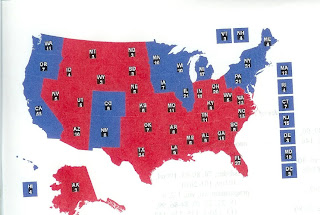
In 2008 I DID THE INTERACTIVE ELECTORAL MAP AT REALCLEAR POLITICS AND CHOSE THE STATES (BLUE) I THOUGHT OBAMA COULD PUT IN HIS COLUMN AND THUS WIN THE ELECTION.

THE GEOGRAPHICAL ELEMENTS WERE SO STRONG THAT IT REMINDED ME OF A PREVIOUS BLOG IN WHICH I SET FORTH A GEOGRAPHICAL THEORY OF POLITICS. IT IS SO PRESCIENT AND SO BRILLIANT (HA HA) THAT I DARE TO REPEAT IT HERE.

THURSDAY, NOVEMBER 18, 2004

A Geographical Theory of Winning in 2008

Look at the electoral maps of 2000 and 2004. The geographical pattern is striking, allowing for minor exceptions. The blue Democratic states are the Northeast, the upper Midwest, and the states bordering the Pacific. The red Republican states are the Southeast, Southwest, lower Midwest, mountain and plains states. A pre-Civil War map showing free (blue) and slave (red) states and territories almost exactly matches the electoral map of 2004.

While electoral maps of many other years would not be this striking, a geographical factor is present, except in blowout years like 1936, 1972, and 1984. Look at it another way. Democrats won the large cities, while Republicans won the small towns and rural areas, with the suburbs split. Divisions are also noticeable with regard to income, education,, religion, race and ethnicity, age, marital status, and gender, but geography is relevant to many of these as well. Zip code is an important clue all by itself.

Since this is a blog and not a book, what can we learn from this? Geography is a useful clue to many other things -- history, economics, religion, and culture. The geography of the South, e. g., was conducive to cotton growing and therefore slavery, which has deeply affected its entire history. Geographical factors account in part for immigration patterns and the Protestant domination of the South.

Geography is a component of, if not clue to, how things worked out in other areas with regard to economics, culture, and religion. So what does this mean for 2008? Assuming that the situation will remain much like it is now in terms of red and blues states as is probable, ask how the blue states can be preserved for the Democrats while reaching out to enough other states that can be likely won to win the election. Some decisions are easy. Massachusetts is probably a safe bet if the Democrats don't do something crazy, but forget Utah for a while. Either Florida or Ohio is probably a must, remembering that a shift of only 70,000 votes in Ohio in 2004 would have given the victory to Kerry.

Looking toward 2008, Democrats live in tension between holding true to their values and getting elected. How to win without losing your soul -- that is the question. With Gov. Mark Warner of Virginia, we risk losing our soul. With Sen. Hillary Clinton, we risk losing the election. My sentimental favorites at the moment are John Edwards and Barack Obama, but time may question the wisdom of one or both. But to begin with candidates, issues, and values is to get the cart before the horse. We need to start with geographical, historical-cultural factors and make a structural analysis of where enough more votes can come from next time to enlarge the number of blue states. Then we can match messenger and message to that purpose.

Relevance and Reality: Bain and Romney

It is charming to listen to the all-wise pundits on the news channels argue about whether the Democratic attacks on Romney's career at Bain Capital are relevant. You mean relevant like in:
  • the swiftboating of John Kerry,
  • the Willie Horton adds against Dukakis,
  • the Harry and Louise attacks on the Clinton health plan,
  • the daisy ad against Goldwater suggesting he might get us into a nuclear war?
Let's get real, let us have some realpolitik here. The adds about Romney and Bain may or may not be relevant  (they are in some respects), but the more important question is do they  work, do they get votes for Obama, turn people away from Romney?

Wednesday, May 09, 2012

Homosexuality and Cultural Change: Mill and Whitehead


The entire history of social improvement has been a series of transitions, by which one custom or institution after another, from being a supposed primary necessity of social existence, has passed into the ranks of a universally stigmatized injustice and tyranny.                                                                                                                                                                      John Stuart Mill
Happened with slavery, denial of vote to women, and segregation, and now with gay rights.
  
It is the first step in sociological wisdom, to recognize that the major advances in civilization are processes which all but wreck the societies in which they occur: -- like unto an arrow in the hand of a child. The art of free society consists first in the maintenance of the symbolic code; and secondly in fearlessness of revision, to secure that the code serves those purposes which satisfy an enlightened reason. Those societies which cannot combine reverence to their symbols with freedom of revision, must ultimately decay either from anarchy, or from the slow atrophy of a life stifled by useless shadows.
                                                           Alfred North Whitehead        

 Sorry, Tony Perkins, you are on the wrong side of history fighting a lost cause.  The moral code is being revised to serve the purposes of enlightened reason.
   

Sunday, May 06, 2012

Advice for Bachelors: When to Change the Sheets

  •  The health department quarantines your house.
  •  The post office will not deliver mail to you.
  •  The dog leaves.
  •  You see a line of bed bugs marching toward the exit.
  •  You see flakes  fall from the sheets when you bend them.

Friday, May 04, 2012

A Glut of Organizations

Americans are distinctive for voluntary organizations (Tocqueville) that promote a favored cause. They are wonderful, do a lot of good. But can it be that more is always better?  Not necessarily.

I have been members of various voluntary groups usually devoted to social justice causes and religion. I can think of several examples in which I doubt that it could be shown that anyone actually benefited from our work.

One was a Theological Advisory Committee for the denomination. We met at wonderful places, had a great time with each other, prepared papers, interviewed guest experts and  made reports. If anyone were saved, sanctified, or inspired to do good works increasing love of God and neighbor, I was not aware of it.

I was once on the board of an interfaith organization. We spent thousands of hours making a video on local poverty to be shown in local churches. We had a big community gathering to celebrate our video and had some success in getting churches to show it. Was even  one poor person helped by all this? Not that I know of.

I and a friend accepted an assignment by our local church when we were exploring future ministries. We took on housing for low and moderate income families. We interviewed town and city officials, investigated the issue as best we could. The most astounding discovery was that in the city and county there were a huge number of organizations working on this issue. Our message to the church was to urge members to join one of these, not to form another organization! Too many already.

I could go listing many other groups  I have belonged to that I doubt ever actually helped anybody.

Emerging needs may call for a new voluntary organization. But this should be resorted to only after it has been determined no existing group is effective or relevant to present circumstances.

Nostalgia for the Bad Old Good Times: The Daily Assault

Life down on the farm in the 1930's and 40's was no picnic.  I have been there, done that. But it had some advantages we have lost. It was mostly quiet and peaceful. You welcomed the mail man who might bring a personal letter or the semi-annual Sears Roebuck Catalog. It was nice to see a neighbor or go to church for some social contact, etc.

Today we are constantly assaulted by:
  • Unwanted postal mail.  If you give to one charity, soon you are receiving requests from forty others of the same or similar sort. This process increases exponentially in this and the following ways.
  • Unwanted email. Respond to one cause, and soon forty others want you to join them, send letters, petition Congress, give to the little boy in Thosmonia dying for the nineteenth time of some horrible disease,  ad infinitum.
  • Unwanted phone calls. The causes that don't send you postal or email call you, usually at dinner time (likely to be home, right?).
  • Unwanted callers at your door. Frequently, these are of a religious sort, wanting to give you literature, talk about your relation to God, Jesus, Thor, or Aphrodite, or convert you to their faith. 
Add to that:
  • the constant fight to keep rid of useless mail, old newspapers, cardboard boxes delivered by UPS or FedEx, and other accumulating stuff that threatens to stuff your living space.
  • the struggle to keep up with the recycling of paper, plastic (everything labeled from 1 to 7), cardboard, and other approved items listed in the annual message from the city.
  • the effort to get the garbage and recycle stuff out on the right day, keeping informed of holidays, when it is a day later.
  • getting the cans and bottles back to the store to get back your nickel per item.
  • finding a place to recycle old electronic items, cords, plugs, dead computers, hard drives, TV's, VCR's, etc.
  • remembering what they said on TV about how to get rid of old prescription medicines without poisoning future generations.
  • remembering what the just-published study said about the foods and medicines that are sure to kill you unless you avoid them.
  • trying to keep up with the requests on Facebook, e. g., becoming friends with or and sending a penguin to someone I don't know.
  • maintaining sanity while enjoying computers: trojans, worms, viruses, privacy settings, broken internet connections, failed hard drives, updating drivers.
  • nuclear issues, proliferation, bombs, terrorists and rogue nations using them, global warming, and on and on and on ............
Ah, for the good old days down on the farm when your main concern was keeping the outdoor toilet and the stable shoveled out, cutting enough cord wood for the stove and fireplace, freezing while you got a fire built on cold winter days, getting to the doctor seven miles away when you got suddenly sick and had no car, hoping the Sears catalog in the outhouse will last til the next one comes, wondering if the chicken in the yard will be big enough to feed the preacher and his family, hoping the drought will not ruin the cotton and corn crops,  worrying that someone will rob your sweet potato hill or smoke house, praying that the next tornado will not blow your house away, that the cow will not go dry, and that your kids will not die of measles, mumps, diphtheria, whooping cough, or get polio. Etc., etc.

"Hey, Sweetie, wanna take the bottles back to the grocery store!"